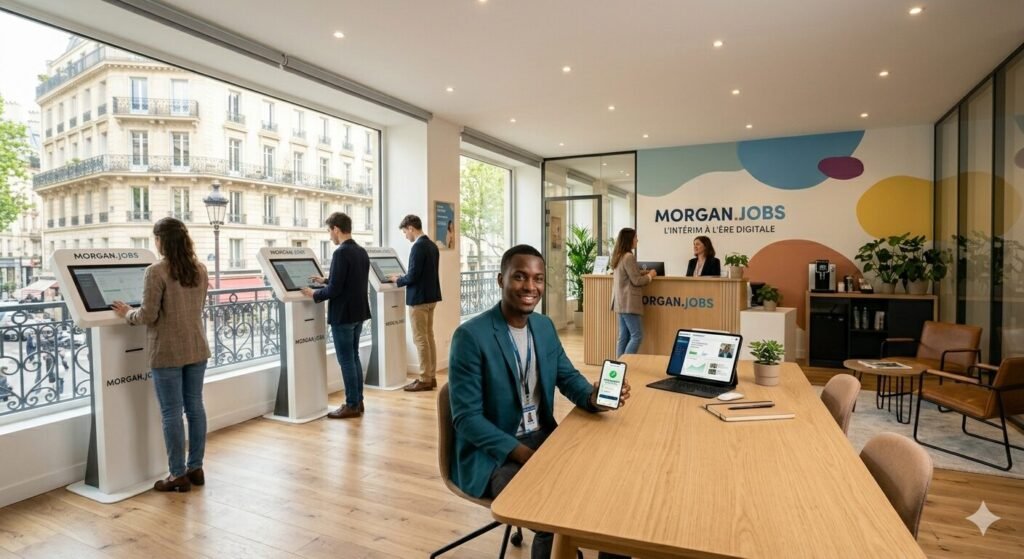
A new era for temporary staffing
France’s labour market is in flux. Temporary work remains a barometer of the economy, with 706 400 people employed in interim roles as of December 2025[1]. At the same time, the sector is undergoing a digital transformation. Traditional temp agencies that relied on paper contracts and in‑person appointments are giving way to digital platforms that match candidates and employers via web apps, automate paperwork and deliver pay electronically[2]. This shift is reshaping how companies hire and how workers access assignments.
What exactly is a digital temp platform?
A digital temp platform manages the three‑way relationship between temporary workers, client companies and temp agencies through an online interface[2]. The core idea is to centralise the entire lifecycle of interim work—from job search and matching to contract generation, time tracking and payslips—within a single environment.
These platforms offer more than just job listings. They perform AI‑assisted matching, handle e‑signatures, store documents in secure digital vaults and integrate with payroll systems. In France, digital temp services are often called “phygital” because they combine an extensive physical network of local agencies with an AI‑driven digital marketplace. Culture RH notes that digital players maintain a network of more than 40 physical agencies to understand local recruiter expectations and respond quickly[3].
How big is the market?
Digital staffing is no longer a niche experiment. Large players handle millions of applications and manage massive candidate pools:
- Gojob’s virtual assistant “Aglaé” can handle the equivalent workload of 130 traditional agencies and processes around two million applications per year[4].
- Iziwork, founded in 2018, raised €12 million in its first funding round and, within a few years, counted 200 000 temp workers and 200 enterprise clients using its digital marketplace[5]. According to company data, it fills 95 % of positions in under four hours, reduces customer turnover by 30 % and delivers 10–30 % cost savings to clients[6].
- Mistertemp’ group, a French leader in digital staffing, has a phygital model combining franchises with an AI platform. Its technology has secured 2.6 million candidates, and the group operates 200 agencies in France and 10 in Italy, employing over 60 000 people for 12 000 clients. The group grew its annual business volume by 25 % per year, reaching €420 million in 2023[7].
These figures show that digital platforms have moved from pilot projects to mainstream solutions.
How digital temp platforms work
- Registration and profile creation. Candidates create an online profile, upload their CV and specify skills (e.g., forklift licences, language proficiency) and preferred locations. Employers create company profiles and post mission descriptions.
- AI‑driven matching. Algorithms match candidates to jobs based on skills, availability and geographical proximity. Some platforms report filling 95 % of positions in less than four hours[6].
- Contract generation and e‑signature. Once a match is confirmed, the platform automatically generates a contract compliant with French labour law. Under the EU’s eIDAS regulation, advanced electronic signatures have legal value; they accelerate signing and reduce paper use[8].
- Mission tracking and digital payslips. Work hours and attendance are recorded through the platform. Payslips are delivered electronically and stored in a digital vault compliant with ISO 14641:2018[8]. Digital payslips are now the norm and support remote access for workers.
- Feedback and ratings. After a mission, both parties provide feedback. Positive ratings help candidates access better jobs and build trusted relationships with employers.
Benefits for employers
- Scalability and speed. Automating administrative tasks (assignment creation, contract drafting, payslip delivery) saves time[9] and allows companies to adapt quickly to demand peaks. Some platforms process millions of applications and fill roles within hours[4][6].
- Access to large talent pools. Digital marketplaces aggregate candidates across regions. Mistertemp’ has secured 2.6 million candidate profiles[7], while other platforms like Culture RH mention 90 000 available workers[3].
- Cost and compliance advantages. Automated processes cut administrative costs and limit errors. Digital platforms handle e‑signature workflows, storing contracts and payslips in secure vaults[8]. Iziwork’s clients report 10–30 % cost savings and lower turnover[6].
- Better matching. AI and data analytics consider skills, availability and commute time, leading to more relevant matches and fewer no‑shows. Ratings provide an additional quality filter.
Benefits for candidates
- Centralised access to jobs. Workers can search and apply for hundreds of missions from one portal[10]. They no longer need to travel between agencies or repeatedly submit documents.
- Transparent compensation and documents. Contracts and payslips are accessible online through secure digital vaults[8]. Candidates receive end‑of‑assignment bonuses and paid‑leave indemnities automatically.
- Personalised matching and fairer opportunities. AI matching accounts for individual skills and constraints, improving fairness. With large candidate pools, niche skills (e.g., CACES certifications) are more easily matched to the right missions.
- Professional development. Many platforms offer training or guidance on certifications (like CACES) and career progression. Feedback loops help workers improve their profiles.
Challenges and best practices
Digital staffing brings clear benefits, but it also introduces new considerations:
- Digital divide. Not all workers have reliable internet access or are comfortable with online tools. Phygital models—with regional agencies that assist candidates—help bridge this gap[3].
- Identity verification. Platforms must verify candidate identities and certifications (e.g., CACES) to ensure compliance and safety. Partnering with certified training providers and conducting digital document checks can mitigate risks.
- Data privacy. Storing contracts, payslips and personal data in digital vaults requires compliance with GDPR and industry standards. Employers should choose platforms that offer secure archives and transparent data policies[8].
Outlook for 2026
With hundreds of thousands of people in interim roles[1] and digital adoption accelerating, digital temp platforms are set to become the default hiring channel for many sectors. Leaders like Mistertemp’, Gojob and Iziwork show that combining AI, scalable tech and local expertise can transform the staffing landscape. As digital signatures and vaults become standard and AI‑matching improves, businesses that embrace these tools will gain a competitive edge.
FAQ
Are digital temp platforms legal?
Yes. The eIDAS regulation governs electronic signatures in the EU. Advanced electronic signatures have legal value for employment contracts[8]. Digital payslips and contracts must be archived in certified vaults compliant with ISO 14641:2018[8].
How quickly can a digital platform fill vacancies?
Some platforms report filling 95 % of positions in under four hours, thanks to AI matching and large candidate pools[6].
What is a phygital model?
It combines digital tools with a local network of agencies. Mistertemp’ operates 200 agencies alongside a digital platform and has secured 2.6 million candidates[7].
Conclusion and call to action
Digital temp platforms are transforming how France hires, offering faster matching, larger talent pools and paperless administration. Embracing these tools in 2026 will help employers access skilled workers quickly while giving candidates transparent, convenient access to missions.
Ready to modernise your hiring? Explore Morgan’s digital staffing solutions and start matching with qualified professionals today.